Climate & Comfort
Al Quoz, Dubai
AC and Climate Automation in Dubai

Photographed on one of our own installations in Dubai. What goes where, and in which finish, is decided room by room at design stage.
Our own installation
Cooling is the hardest working system in a Dubai property. It runs for most of the year, and in a great many homes it's still governed by a thermostat in a hallway that knows nothing about who is in the house, what time it is, or whether the afternoon sun is sitting on the west glazing. Climate automation gives that thermostat the information it was always missing, then acts on it room by room.
- Coverage
- Across Dubai
- Stage
- New build and retrofit
- Scope
- Design, installation, support
Quick answer
In brief
AC and climate automation brings air conditioning under room-by-room control: a sensor and setpoint per zone, schedules that follow the household, setbacks for empty rooms, and a holding mode while a property is unoccupied. Vertex Automation installs it in Dubai villas, apartments and offices, usually on the existing ducted, central or split systems. A survey confirms what the installed equipment supports before anything is recommended.
Key facts
| Service | AC & Climate Automation in Dubai |
|---|---|
| Property types | Villas, apartments, penthouses and offices |
| Coverage | Dubai, United Arab Emirates |
| Based in | Al Quoz, Dubai, United Arab Emirates |
| Project stage | New build and retrofit |
| Delivery | Design, installation, programming and support |
| Phone and WhatsApp | +971 50 956 3041 |
How it works
Designed as one joined-up system, not a list of devices.
01
One setpoint per area, not one per hallway
Zoning is where most of the comfort comes from. Bedrooms, a majlis, a study and an open-plan living area rarely want the same temperature at the same hour, and a single wall controller can only average them. With a sensor in each area and control at the unit or the damper, every zone holds its own setpoint. On a ducted system that means motorised dampers and per-room sensors working from one machine. On a property running several split units, each unit is already its own zone and simply needs control that reflects the room, not the corridor.
02
Schedules for the week, occupancy for the exceptions
Schedules do the ordinary work and occupancy handles the exceptions. A schedule pre-cools bedrooms before sleep and eases them back once the household is up, keeps living areas ready through the hours they are genuinely used, and runs a different pattern at the weekend. Occupancy and door sensors catch what a schedule cannot predict: a guest room used unexpectedly, a study empty all afternoon, a family that leaves early. Manual changes are always respected, and the schedule resumes at the next transition instead of fighting whoever last touched the panel.
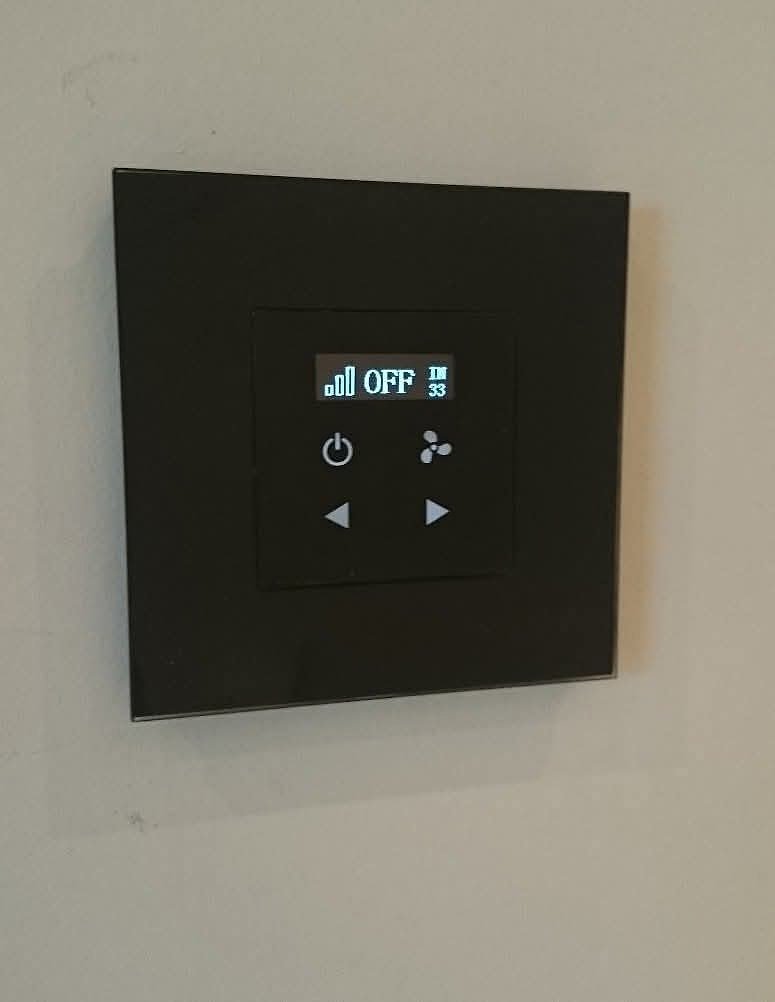
Matte black, flush to the wall. The control behaves the same whichever finish a room takes, so the choice is an interiors decision rather than a technical one.
Our own installation
03
Why shading is part of the cooling design
Shading and cooling belong in the same conversation. A large share of the heat an air conditioner removes from a villa here arrived through glass an hour earlier. Closing curtains or blinds on a facade before the sun reaches it means less heat to remove afterwards, which is a gentler form of saving than pushing setpoints up and asking the household to live with it. When shading and climate sit on the same system, that happens by schedule and by sun position, west elevation in the afternoon, east in the morning, without anyone having to decide to do it.
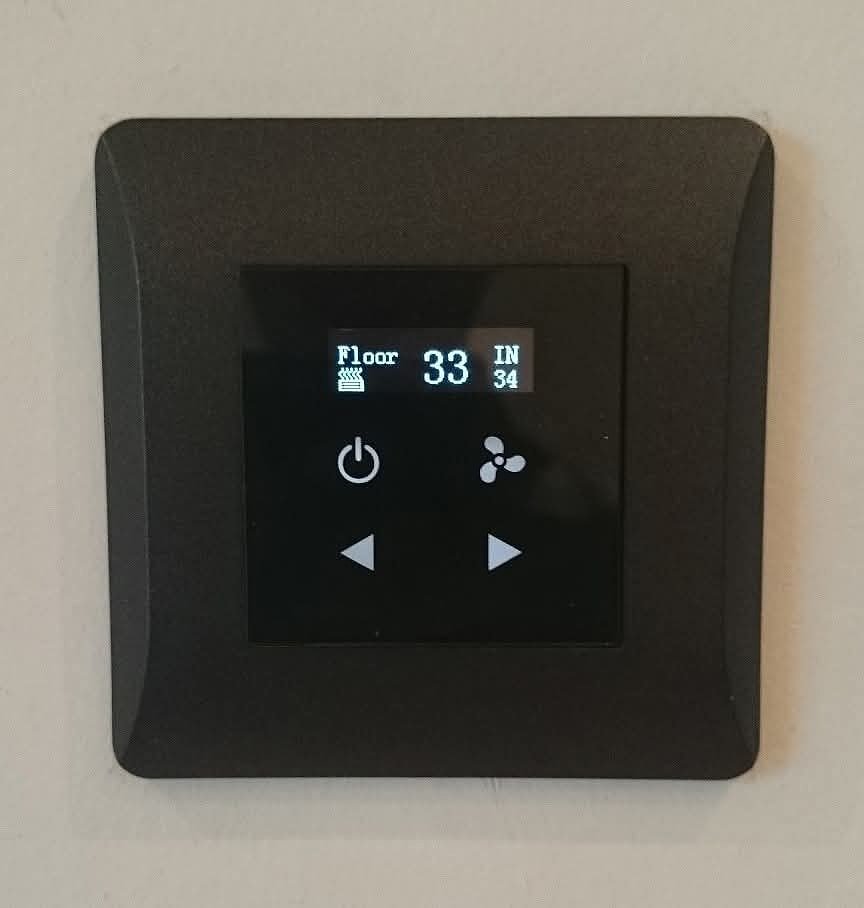
A room reading its own temperature. Each zone carries its own schedule, so a bedroom that is empty until midnight stops being cooled as though it were full.
Our own installation


Demonstration
AC & Climate, in use
A page-sized study of the service in context. Final scenes and controls are written for the rooms and routine.

Cooling for the day
Climate steps up gently and shading manages the sun.
Climate
Cooling
Ceiling fan
Stopped
Curtains
Simulated for this page. Scenes are written per project, around the rooms and the routine.
Illustrative
What it gives you
What zoned cooling feels like day to day
Hardware is the means. These are the things you notice once the system is live.
01
Every room at its own temperature
Bedrooms, a study, the majlis and an open-plan living area rarely want the same setpoint at the same hour. A sensor in each area and control at the unit or the damper lets each one hold its own, so nobody has to choose between a cold living room and a warm bedroom because one hallway thermostat is deciding for everybody.
02
Cooling that follows the household
Schedules handle the ordinary week: bedrooms pre-cooled before sleep and eased back once everyone is up, living areas ready for the hours they are used, a different pattern at the weekend. Occupancy sensing handles the rest. Rooms nobody is in ease back on their own, and come back before you notice they went.
03
Shading and cooling on the same side
Much of the heat an air conditioner removes arrived through glass a little earlier. When curtains and blinds run on the same system, shading closes on a facade before the sun reaches it and reopens once it has passed, so there is less heat to remove in the first place. It is a quieter kind of saving, and nobody in the house has to feel it.
04
The whole property, visible from anywhere
Temperature and humidity for every zone sit on one screen, wherever you are. Bring the house down to temperature before you land, drop an empty property to a holding setpoint from the departure gate, or check that a room you rarely enter is not sitting in the heat all summer.
Scope
What a climate project covers
Set at design stage, from the property and your priorities, never from a fixed package.
- Survey of your existing AC type, zoning potential and control wiring
- Smart thermostats matched to ducted, central and split systems
- Room by room zoning with motorised dampers where the ductwork allows
- Temperature and humidity sensors positioned away from glare and supply air
- Weekday, weekend and seasonal comfort schedules
- Occupancy-aware setbacks for rooms nobody is using
- Away and holiday holding modes for the whole property
- Shading and cooling coordinated on the same schedule
- Remote monitoring and control of every zone from one app
- Documented zone map, setpoints and schedules at handover
Project detail
Climate is the system with the most to gain from company. Curtains and blinds close against the afternoon sun before rooms heat up, not after. The occupancy information gathered for lighting also tells the climate which rooms are empty, so one set of sensors does two jobs. A single leaving action sets every zone back, switches off the loads you nominated and arms security, and a single arriving action undoes it. Because all of it runs on one platform, the same wall panel, the same app and the same schedule handle cooling, light and shading together, and there is one design to explain when something needs changing.
In a new build or a serious renovation, climate control belongs on the drawings: zone boundaries agreed against the room layout, damper positions coordinated with the AC contractor, thermostat and sensor locations chosen away from glare, kitchens and supply air, and control wiring pulled before the ceilings close. In an existing property, most systems can be brought under control without replacing the units. Ducted and central systems are usually controlled at the existing wall controller position, and split units through compatible interfaces at each unit. What a property supports depends on the make and configuration of what is already installed, so the survey settles that before anything is recommended.
In Dubai
AC & Climate in Dubai
Climate, regulation and the way this city builds all shape the specification, before any equipment is chosen.
Cooling runs for most of the year here and usually accounts for the largest single share of a home's electricity use. That's the climate at work, not a cause for alarm, but it does mean the settings are worth getting right. Two habits are worth naming. Setting a thermostat far below the temperature you actually want doesn't cool a room faster, it only means the system overshoots and runs longer than it needed to, so a sensible setpoint held steadily is both more comfortable and less work. And humidity matters as much as temperature for how a room feels: a property held at a reasonable temperature with humidity under control feels better than a colder, damper one. Both are things a designed system holds consistently and a wall dial cannot.
The city's rhythm shapes the rest. Families travel for weeks in summer, apartments sit empty between tenants, and villas host guests late into the evening. A holding mode keeps an empty property protected from heat and humidity, which matters for joinery, timber floors and finishes, without cooling it as though it were full. Villas often run several outdoor units serving areas used at completely different times of day, which is exactly where zoning earns its place. And because the season is long, small habits repeat thousands of times, so a schedule that quietly matches your actual day is worth more than any single adjustment you remember to make.
Questions
Climate control, the usual questions
Usually, yes, and without replacing the units. Ducted and central systems are generally brought under control at the wall controller position, with a smart thermostat taking over from the existing one. Wall-mounted splits are controlled through a compatible interface at each unit. What matters is the make and configuration of the equipment, which we confirm during the survey before recommending anything. Replacing air conditioning simply to make it controllable is rarely the answer, and we'd tell you if your system were the exception.
Yes, and it is the change owners notice first. On a ducted system, motorised dampers and a sensor in each area let one machine serve several zones at different setpoints. On a property running multiple split units, each unit is already a zone and only needs control and a sensor that reflects the room. The practical limit is the ductwork: where several rooms share one branch they behave as a single zone, which is something we map during the survey so the zone plan matches what the property can genuinely do.
It removes cooling that nobody was benefiting from, which is where any saving comes from, and we would rather explain the mechanism than quote a figure we cannot stand behind. Empty rooms ease back instead of being held at the same temperature as occupied ones. The property drops to a holding setpoint when everyone is out instead of staying ready for nobody. Shading cuts solar gain before the system has to remove it. How much that adds up to depends on the property, the equipment and the household, which is why we won't put a percentage on it in advance.
Hold, rather than stop. Switching cooling off entirely for weeks lets heat and humidity build, which is unkind to timber, joinery, artwork and leather. A holding mode keeps the property at a moderate setpoint with humidity in check, using far less energy than an occupied week, and you can see the temperature of every zone from wherever you are. Landlords use the same arrangement between tenants. Before you land, one action brings the house back to a comfortable temperature.
Yes. The thermostat or controller stays where it always was, usually replacing the existing one in the same position, and anyone can walk up and change a room the ordinary way. Automation sets the baseline; it doesn't lock people out. A manual change is respected until the next scheduled transition, at which point the schedule resumes on its own, so a guest adjusting a bedroom overnight does not quietly redefine how the house runs from then on.
Start with a look at your system
Tell us what air conditioning the property has and how the household uses each room. We'll survey what is installed, map the zones it can realistically support, and set out what zoning, scheduling and remote control would involve.
Villas, apartments, penthouses and offices across Dubai. New build, refit, or a system somebody else left you with.
Also in the system
What this usually goes in with
Specified, wired and commissioned by the same team on the same drawings, which is the reason they behave as one afterwards.
Smart Curtains
Quiet motorised curtains, sheers and blinds that move with your scenes and manage sun, heat and privacy.
Home Automation
Lighting, climate, curtains, security and entertainment designed as one system, controlled from one interface.
Office Automation
Meeting rooms that start on one touch, occupancy-aware lighting and climate, access control and dependable networks.